Showing posts with label Reading. Show all posts

Wednesday, October 17, 2018

Week 9, Reading B: How the River God's Wedding Was Broken Off

As in most of history, those who hold power will try and keep it by creating fake customs that keep the rest of the population in fear. Such is the setting of this story, until a wily governor arrives to stop the situation. This story, How the River God's Wedding Was Broken Off, comes from The Chinese Fairy Book, by R. Wilhelm.

Reading Notes
  • A district on the Yellow River was ruled by a governor called Si-Men Bau.
    • The people in the district held the River God in high esteem.
  • The witches and sorcerers who lived in the area declared that every year, a young woman must be selected as a bride, otherwise the weather would be bad for the year and there wouldn't be a good harvest.
  • Whenever a daughter in a wealthy family came of age, the sorcerers and witches would say she should be the bride.
    • The family would then try to bribe the sorcerers and witches, until they finally ordered the family to buy a poor girl to cast into the river.
    • The sorcerers and witches would keep the bribes, of course.
    • If a family didn't offer a bribe, the sorcerers and witches would order the daughter be thrown into the river to be the river god's bride, with wedding gifts and all.
  • When Si-Men came into office and heard about this custom, he told the sorcerers and witches he wanted to come along and see the custom, as well as honor the god, so that the god would shower pleasantries on the people of the district.
  • Upon the day, Si-Men dressed in his finest and rode in his chariot to the place where the bride would be forced into the river.
    • Everyone from the district was there, including the sorcerers and witches, and there was music and singing.
    • The river-bride was sitting in a coach adorned in jewelry, and tearfully telling her parents goodbye.
  • Right before the river-bride's coach was pushed into the stream, Si-Men interrupted and declared that someone must go into the river and fetch the river-god to retrieve his bride.
  • He ordered a witch to go into the river to fetch the god, and when she hesitated he had his servants grab her and thrust her into the water.
    • An hour passed by without anything happening.
  • Si-Men declared that the witch was moronic for not understanding her directive, and ordered a sorcerer to go into the water.
    • Like the witch, the sorcerer hesitated and thus was forced into the stream; another hour passed by without event.
  • Si-Men pretended to be upset about this turn of events, and started to order another sorcerer to go into the water.
    • However, the remaining sorcerers and witches threw themselves on the ground before Si-Men and begged for mercy, and swore they would end the practice of a river-bride that day.
  • Si-Men sent the river-bride home to her family, and thus the evil practice came to an end.

The Yellow River is one of the largest rivers in China. (Source: Wikipedia)

Week 9, Reading A: Why Dog and Cat are Enemies

Every culture has an explanation story, and a popular one is why cats and dogs don't get along. China is no exception: this translation of "Why Dog and Cat are Enemies" comes from The Chinese Fairy Book by R. Wilhelm.

Reading Notes
  • A man and his wife sold a lucky gold ring for cheap, not knowing its true value or that keeping it meant they would always do well.
    • After selling it, they start to grow poorer and poorer, until they run low on food.
    • Consequently, their cat and dog also go hungry.
  • The cat and dog discuss among themselves what to do.
    • The dog realizes the only recourse is getting their owners back the ring.
    • The cat responds that the ring has been locked up in a chest.
    • The dog develops a plan: the cat must catch a mouse and threaten it to naw its way into the chest and pull the ring out.
  • And so they proceed: the cat catches a mouse, and with it and the dog set off for the house that holds the ring.
  • On their way they come to a river, and the dog carries the cat across on his back, since the cat can't swim.
  • Everything goes as planned: the cat takes the mouse to the chest, the mouse chews its way in and pulls out the ring, and the cat takes the ring and goes back to the dog.
  • The dog swims across the river again with the cat on his back, and then they set off for home.
  • The dog is stuck running on the ground, since he can't climb, and has to run around houses.
    • But the cat can climb the houses and run over the roofs, so she makes it home before the dog does.
  • When she arrives home and presents the ring to the couple, they praise her and declare they will treat her just like their child.
  • However, when the dog makes it home, he's punished for not helping to get the ring home.
    • The cat just sits by the fireplace and doesn't do anything to correct the couple. 
  • When the dog realizes the cat is going to allow him to be cheated from his reward, he tries to fight her.
  • And that's why the dog and cat are enemies.

(Source: Wikipedia)

Wednesday, October 3, 2018

Week 7, Reading A: The Twin Brothers

In the Congo, family and sibling rivalries are common, as is demonstrated in The Twin Brothers, from the Notes on the Folklore of the Fjort, by Richard Dennett.

Reading Notes

  • Twin boys are born almost fully grown (the poor mother), each with his own fetish, a charm for magical powers.
  • The elder one, Mavungu, decides that he wants to set out and explore.
  • Meanwhile, the daughter of Nzambi is at marrying age, but he won't make her marry anyone unless she says so. 
    • A bunch of animals ask for her hand, but she turns them all down.
  • Mavangu hears of this and decides he wants to marry her.
    • He uses his charm to turn a bunch of blades of grass into different tools (a knife, a gun, a horn, etc.) until he is ready to travel.
  • Mavangu sets off, and the charm helps to feed him along the way by providing food  and a place to sleep upon request.
  • Nzambi's daughter falls in love with Mavangu upon sight, and they are quickly married.
  • The next day, Mavangu sees that the hut has mirrors all over the place, but that their all covered.
  • He tells his wife he wants to see the mirrors, and she uncovers all but one.
    • Each mirror reflects a different village, including his home one.
  • Mavangu demands to see the last mirror uncovered, and his wife initially refuses, telling him that everyone who sees the last one wishes to travel there, but never returns.
    • However, he insists and she reluctantly shows him.
  • Naturally, Mavangu wants to travel to the town as soon as he sees it, and despite his wife's pleading he does just that.
  • Mavangu travels by horse until he comes close to the town, and meets an old woman on the outskirts.
    • He asks her for fire to light his pipe; she tells him to tie up his horse and to come and get it.
    • He ties his horse up tightly, and as soon as he comes near the old woman she kills him.
  • Meanwhile, Mavangu's twin brother Luemba wonders at Mavangu's long absence, so uses his charm to turn blades of grass into tools and sets off on his brother's trail. 
  • When he arrives, Nzambi mistakes him for Mavangu, as does everyone else, and they refuse to listen to Luemba's claim that he isn't his brother.
  • That night, Luemba uses his charm to take his sister-in-law out of his room, so he doesn't sleep with her.
  • The next day, Luemba asks and is shown the mirrors like his brother, and upon seeing the town reflected in the last one realizes his brother is still there, and decides to go rescue him.
    • None of his in-laws are happy, but relent because, mistaking him for Mavangu, they realize that if he can return once, he can return again.
  • Luemba traces his brother's path and comes across the old woman as well, asks for fire, and is given the same answer as his brother.
    • Unlike his brother, Luemba only ties his horse up lightly, and then kills the old woman.
  • Luemba finds the bones of Mavangu and his horse, and uses his charm to resurrect them.
    • The two brothers then use their charms to resurrect hundreds of other people who suffered the same fate.
  • Luemba and Mavangu head back to Nzambi's town with their followers, and Luemba informs Mavangu of what happened when he was dead.
  • Then they start to quarrel over who should have the followers.
    • Mavangu feels he should, as the oldest, while Luemba feels that none of them, including his brother, would be alive without him.
  • Mavangu kills Luemba in anger and leaves his body behind with his horse, taking the followers back to Nzambi's town and being welcomed.
  • Luemba's horse takes his charm and uses it to resurrect Luemba.
    • Luemba promptly seeks out and kills his brother, which everyone agreed was his right to do.
Twins are significant in African mythology, as they are believed to represent the balance of the forces in the world. (Source: Myth Encyclopedia)

Wednesday, September 26, 2018

Reading Notes, Part B: Khasi Folktales, The Leap of Ka Likai

In a similar tone to Greek/Roman myths and the Grimm Brothers tales, The Leap of Ka Likai, from K. U. Rafy's collection of Khasi folk tales, features a stepparent jealous of a child and some cannibalism.

Reading Notes
  • The Leap of Ka Likai is the name given to a waterfall in India.
    • It's very pretty, but it's known for giving off a loud, angry sound where the water hits the bottom of the mountain. 
    • This story is about why it gives off such a sound.
  • In a village on the hills above the falls, Likai was happily married with an infant daughter.
    • But when her husband died, Likai ended up marrying again, mostly for the sole purpose of making sure her daughter would be cared and provided for.
  • Her new husband, not the best man to begin with, was angry at the attention his new wife gave his stepdaughter, and when he found out that Likai married him solely to ensure care for her daughter, he swore to hurt the child in some way.
  • So the man refused to do any work and made Likai go out, and when left at home would abuse his stepdaughter.
  • One day, when Likai had to leave for a longer period of time than usual, the man killed his stepdaughter and cooked portions of her into a dinner.
  • When Likai came home, she was suspicious of her husband's seemingly generous mood, but accepted his excuses for the child's absence and ate the dinner without question.
  • Afterwards, she went to chew on a betal leaf as she usually did, and found her daughter's severed hand in the basket. 
    • She questioned her husband, who told her everything, including that she had eaten the flesh of her daughter.
  • Likai went mad with grief and threw herself over the falls; the sounds that echo up from the bottom are said to be echos of her cries.
    • Her story is also used as a warning for any widows with children who are considering marrying again.
The Nohkalikai Falls in the East Khasi Hills (source: Wikipedia)

Tuesday, September 25, 2018

Reading Notes, Part A: Khasi Folktales, How the Dog Came to Live with Man

Stories that tell the origin of something are always pretty interesting to me, so naturally I was drawn to the Khasi Folktale about How the Dog Came to Live with Man, from K. U. Rafy's collection. This is something that a lot of cultures visit a lot, but I like this take on it. It implies that the dog is crafty, which is usually not the case in other stories.

Reading Notes
  • The most important fair of all has arrived, and according with degree, each animal must bring something of some sort of value that can be sold.
    • Man was an enemy of the animals, so he wasn't invited.
  • The dog, being ironically lazy, didn't want to make something himself like the others, but instead decided to wander the countryside all day looking for something he could pass off as his own.
  • At the end of the day, he chanced upon a house where a family was eating fermented Khasi beans.
    • Being nice, the wife invited the dog to eat with them, which he gladly did.
  • Afterwards, realizing he could take the Khasi beans to the fair, the dog bargained with the family and ended up leaving with a clay pot of beans strapped to his back.
  • On the way to the fair, he bragged so much about his jar that the other animals were all very curious to see what he had.
  • Unfortunately, when the dog finally uncovered the jar, a bad smell came out; all the other animals made fun of the dog, and eventually destroyed the pot and trampled the food into the ground.
  • The dog tried to get the governor of the fair, the tiger, to intervene, but was just told off.
  • The dog eventually lost his temper, cursed all the animals, and ran away, where Man consoled him and offered the dog a place in his home.
    • The curse worked, because the stench of the food clung to the other animals, and so the Dog was able to track them for Man when out hunting.
  • Later, when Man had tamed Pig, he noticed Pig and Dog being lazy and decided to put them to work, sowing furrows in the field.
    • The Pig did a lot of the work, while Dog lazied around and jumped all over the furrows the pig had made.
  • Eventually the pig got tired of this, and complained to Man, who was loath to believe that Dog would be so lazy.
    • When Man inspected the work that had been done, he found the tracks of Dog all over, while only a few tracks of Pig's
    • Man decided that Pig had lied, and to punish him, made him sleep in a small separate shack and eat slop while Dog got to stay in Man's house and eat a normal dinner.
Ktung rymbai, also called tungrymbai; it's made from fermented soybeans (Source: Treebo)

Wednesday, September 19, 2018

Reading Notes, Part B: Tales of a Parrot, A King Falls in Love and the End of Khojisteh

Yesterday I took notes over the beginning of Tales of a Parrot by Ziya'al-Din Nakhshabi , and today I'm going to take Notes over the End. It's titled A King Falls in Love and the End of Khojisteh, and it's the last portion of the story. So, as a reminder, Khojisteh is the wife of Miemum, who's away on business. Khojisteh wants to go see a neighbor who she finds attractive, but Miemum's parrot stops her every night by telling a story she finds interesting.

Reading Notes
  • Khojisteh tells the parrot to leave her be and let her go see the neighbor, but the parrot manages to trick her into hearing another long story.
  • In this story, a king raids a nearby kingdom to get the emperor's daughter for a wife; it works (shocker)
  • The wife has a son who she gets separated from as part of her marriage, and was warned by her dad not to mention her son to her new husband.
    • But she misses her son, and wants him to come live with her.
  • One day she lies to her husband and says her father has a slave who is good at distinguishing jewels, and he decides to send a merchant to fetch this person; in private she tells the merchant the truth, that the person he is to fetch is really her son, whom she wants to come live with her.
    • The merchant does so.
  • When the king leaves on a day errand, the queen calls her son to her and shows him affection.
    • The king's porter sees this and tells the king, who immediately thinks the queen has brought her lover to the castle.
  • The king wants revenge and orders the death of the son; but executioner questions the son, and upon being told the truth, decides not to kill him.
    • Instead, the executioner hides the son and lies to the king that he carried out the order.
  • The king is still irritated over the whole thing, and the queen isn't sure what to do about it.
  • One day, the queen talks to an old woman about the whole affair, and the old woman explains she can fix everything. 
  • The old woman gives an amulet to the king and tells him it makes someone tell the truth in their sleep.
    • Then the old woman immediately tells the queen to fake being asleep and to tell the king the truth when he puts the amulet on her.
  • Everything goes smoothly, and the king and queen find out her son is still alive, and everything is fine again.
  • Meanwhile, the parrot has managed to stall Khojisteh into the morning, so she still doesn't leave.
  • That day, Miemum returns home, and the parrot basically immediately tells him everything, and Miemum kills Khojisteh.
    • I have to add that this is a really stupid ending. Clearly the author just wanted to convey these short stories in one book for whatever reason, and as soon as the stories were done he was like "welp, gotta wrap this up in 200 words or less!"
    • Although a quick Google search showed that some people have retold the story so that, while Miemum is initially angry, the parrot tells a story of forgiveness and Miemum ends up reconciling with Khojisteh, so I suppose it depends on what version you read.
The parrot stalling Khojistah from leaving (Source: Culturama)

Reading Notes, Part A: Tales of a Parrot, Khojisteh and the Parrot

The Tales of a Parrot collection by Ziya'al-Din Nakhshabi is in some ways a different version  of 1001 Nights, but instead of a woman telling stories to stay her execution, a parrot is telling stories to stop his master's wife from cheating on him. This story, Khojisteh and the Parrot, is how the wife finds herself with an eye wandering to a different man, and how the parrot decides to try and subtly stop her from doing anything.

Reading Notes:
  • Miemum, the husband and owner of the parrot, must leave to go on political business, apparently (I'm assuming so since he's a prince).
    • His wife, Khojisteh is very sad about this and won't eat or sleep
  • For the next six months, the parrot tells her pleasant stories to make her feel better.
  • But, at the six month mark, Khojisteh looks out a window and sees another prince who's visiting the area.
    • Both find the other attractive, and the prince sends Khojisteh a message asking her to privately meet him that night.
  • That evening, Khojisteh puts on her finest clothes and jewelry and decides to tell the sharuk about what's happening, assuming the sharuk will basically give Khojisteh her blessing.
    • On that note, I have no clue what a sharuk is. The only thing Google gave me was a mythological bird that apparently rescued Sinbad the sailor, which doesn't really fit with the story.
    • But apparently the sharuk is a bird, because the sharuk chastises Khojisteh for her actions and Khojisteh ends up pulling the sharuk from her cage and killing it.
  • Khojisteh then goes to the parrot, who, not wanting to die like the sharuk, placates Khojisteh and subtlety mentions the parrot of Ferukh Beg, which gets Khojisteh's attention; she asks for the parrot to tell the story.
Khojisteh talking to the Parrot (Source: Wikipedia)

Thursday, September 13, 2018

Reading Notes, Part B: The Odyssey, Sirens, Scylla, and Charybdis

Having managed to escape from the cyclops, Odysseus and his men sail on, encountering the witch Circe on her island. Eventually, they escape from her as well, but with warnings of the sirens and the two sea monsters, Scylla and Charybdis. This story, from Kline's translation of Homer's Odyssey, sums up the last of his adventures, after which it returns to the present setting (Odysseus telling his story to the people who found him washed up on shore).

Reading Notes
  • Odysseus explains to his men that he wants to hear the sirens' song (although he doesn't appear to explain why) and what he has planned for them.
    • The sirens' song lures men to their death (the sirens eat them)
  • The crew all stuff their ears with wax, and Odysseus is tied to the mast of the ship.
  • Although he is enchanted by the sirens' song, he can't break free of the ropes, and as the men can't hear him, they don't obey his order to let him free.
  • They free him after they're out of range
    • This gets copied a lot in various fictions
  • They go towards the two sister sea monsters, Scylla and Charybdis
  • Odysseus was warned of them by Circe, but he doesn't totally obey her instructions about staying unarmed.
  • Charybdis is a whirlpool, while Scylla is a six-headed monster.
  • The ship is so focused on avoiding Charybdis that Odysseus loses six of his crewmen to Scylla, who eats them, one per head.
  • Odysseus describes the site as the saddest thing he's seen on the sea (this from a man who fought a ten-year-long war).

I feel like Odysseus was probably tied more securely to the mast than is shown. (Source: Wikipedia)

Tuesday, September 11, 2018

Reading Notes: The Odyssey, Prisoner of the Cyclops (Part A)

Homer's Odyssey has often been recreated and retold throughout the years. One story that shows Odysseus' famous wit and cleverness is the story of the Cyclops, although this reading focuses on how he and his crew became prisoners (Source: Homer's Odyssey, by Kline)

Reading Notes
  • Homer takes VIW (Very Important Wine) with him off the ship, because his gut told him too (whatever you say bro)
  • The language is very flowery and detailed, as to be expected (he goes into a lot of detail about how important the VIW is)
  • His men want to rob the so-called savage whose cave they find and enter, but Odysseus says no, because he wants to see how hospitable the savage is
  • Although they still start a fire without warning and eat the savage's food, so I don't see how that's any different than what his men wanted, apart from leaving them vulnerable.
  • Apparently the giant isn't very observant, as he entered the cave with some of his flock, sealed it, milked the goats that came inside, and treated the milk, all before seeing the intruders (I get they slipped into a corner but still)
  • Odysseus introduces himself, and lies to the giant about where the ship is because the giant shows no pity to him or the others (he also gives a really long introduction)
  • The cyclops kills two of his men, eats them whole, and then falls asleep with no worry about the little men trapped in his cave.
  • Odysseus' first thought is to kill him, but realizes that would be stupid, as he and his men can't move the rock blocking the entrance.

Odysseus and his men eventually manage to free themselves from the cyclops, but not without danger (Source: Wattpad)

Wednesday, September 5, 2018

Week 3, Reading B: Ovid's Metamorphoses, Narcissus

As often happens with Greek/Roman myths, the main character/occurrence in the story makes its mark in the English language by becoming the root of a common word. Here, we see why Narcissus (this version of the myth is from Ovid's Metamorphoses) is the root for the word narcissism, and all the other words that derive from that.

  • This version is a lot more poetic than the story of Phaethon I read yesterday, it seems.
  • Definitely this version was meant to be read out loud, not read from paper.
  • Lots of poetic imagery, as usual.
  • It's weird because Narcissus is aware that he's in love with his own reflection, but he doesn't care.
    • In my initial reading, my thought was "Narcissus isn't that bright, to fall in love with his own reflection. After all, one feature of cognitive development in children is when they recognize that what's in the mirror is a reflection."
    • But again, he does know what's happening, he just doesn't care.
  • Also shows how in mythology, prophecies always come to pass, no matter what is or isn't done to avoid them.
  • In the end, a tragedy for both Narcissus and Echo (who really didn't do anything wrong except to make Juno angry, but I digress).
    • Both of them end up dying/unhappy
  • Side note, apparently the flower Narcissus turns into is known for growing by water and bowing so it looks like it's looking at its own reflection. Therefore, it's Narcissus forever looking at the reflection of one he can't have.
  • Also, basically it was someone Narcissus rejected who started the whole thing (so again, the gods just kinda doing stuff at their whim).

So in this picture, we have Narcissus looking at his reflection, while Echo looks at him (Source: Greek Myths & Greek Mythology)

Tuesday, September 4, 2018

Week 3, Part A Reading: Ovid's Metamorphoses, Phaethon and the Sun

The story of Phaethon and the Sun (from Ovid's Metamorphoses) though often confused with the story of Icarus, is very different, although both have the themes of fathers and the folly of thinking too much of yourself. 

Notes: 
  • Since the story does technically start right at the end of another, it has a smooth transition from one main character to another.
  • There's lots of declaring, from feelings to truths and on.
  • Also lots of description of things, such as the palace of the Sun.
  • As with everything else in Greek/Roman mythology, all the nouns are personified (such as the Hours, Day, Month, etc.)
  • Everything is all very poetic and about upholding honor and promises
  • And of course, the danger of making a promise you can't keep (Apollo saying he'll do anything to show Phaethon that he is his father, then Phaethon making a suicidal request)
  • And of course, the arrogance that just because of one's parentage, you can do the same things they did (or just the dangers of being arrogant in general).
  • Again, more poetic descriptions and warnings, etc, etc.
  • And of course, Dad gives into his son's demand because he can't break a promise
And so off Phaethon goes on the chariot that is drawn by the flaming horses. What could go wrong? (Source: Vanessa Leung)

Wednesday, August 29, 2018

Analysis of Anthology Stories (Reading Notes)

Reading Notes: 

The Man in the Moon, by Fleeson; from Laos
  • This story is pretty similar to others, such as the stonecutter man who does the same thing as the character, but wishes himself to be the strongest thing on earth, ends up wishing to be a mountain, and realizes that a stonecutter is mightier than a mountain. So the same premise, but very different endings and "morals".
  • Pretty simple story, shows it's easy to find someone who is stronger than you. 
  • Repetitive (as most myths are); i.e., the plot and previous actions are repeated over and over.

A still from the film 'A Trip to the Moon.' (Source: Wikipedia)

Pygmalion, translated by Kline (Greece/Roman)
  •  Lots of scenery and detail (think like Dickenson and how he described everything in excruciating detail)
  • Flows fluidly, describes in the present tense.
  • Also describes his senses (ex: when he discovers the statue is alive, it's done by describing the sensation of the former ivory skin first).
Pygmalion in awe of his creation. (Source: ThoughtCo.)

  • Makes it sound like it's the same character in all four stories, although that's probably not the case.
  • Not a lot of flashy detail like Pygmalion, but still gets the message across.
  • Short and simple, short and powerful.
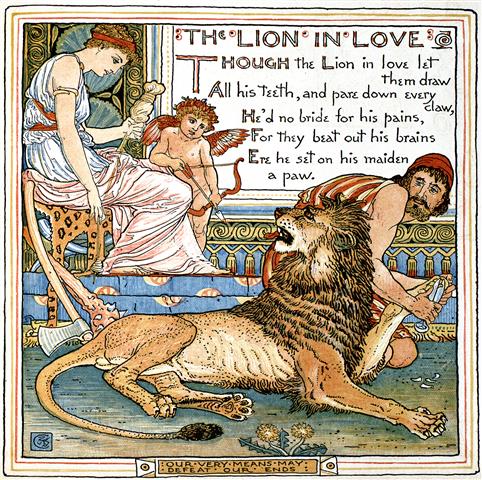
A title page for "The Lion in Love." (Source: Fables of Aesop)

  • Pretty similar to the familiar "Beauty and the Beast" story everyone knows.
  • Has a more modern style than the others, but still formal. 
  • A twist! There's a mother, but no father.
  • Still follows the "you freed me, you have to marry me now" troupe that happens a lot. I mean, she was with a beast for three days, there's no way she really loved him. At least Belle spent a season with the Beast.
The Basilisk lizard, aka the Jesus Christ lizard. The story is less scary if you picture this on the girl's lap. (Source: National Geographic)

First Impression of Reading Options

I will admit, looking at all the options for readings did get me excited. A lot of these are stories that I've become familiar with due to my reading habits (such as a lot of the Grimm Brothers stories, Alice in Wonderland/Through the Looking Glass, and the Greek myths), but its still exciting to see both old favorites and interesting new ones.

In no particular order:

It would be fun to retell a familiar story, although it would be easy to become repetitive (as a lot of the stories get eventually). Maybe a modern retelling (although talk about repetitive).

Definitely would be interesting, as I don't think there's a lot of information available about Alaskan mythology. So far seems to have similar themes to Native American ones, but maybe there's some variation I didn't see while skimming.

After hearing a Russian folktale on the podcast Myths & Legends (which I'll be double-checking for ideas), I'm definitely curious to check out more stories from there. From what I remember the story from the podcast had no moral or happy ending, which is unusual but a nice breath of fresh air.

Riddles are always fun, and the overall plot sounds interesting. Kinda sounds similar in premise to 1001 Nights (captive telling stories to extend their life/pass the time). Definitely need to pursue some more

I did try and read this once, as the public library has the complete editions from Penguin House. But I couldn't get through the first book; all the combining stories got really confusing for me. Definitely want to try again though, and I think I could have fun rewriting them.

And a fun image to wrap this post up:

Ah, the days before technology. (Source: Mystery Fanfare)